
 EN
EN  DE
DE Biography
"Passion for Timeless Circular Forms" (NWZ, 30.09.2026)
Profile Wooden sculptures by the Aichelberg artist Herbert Michael Staudigl are being exhibited at the Rudolf Steiner House in Stuttgart. Spherical sculptures and color circles serve as fundamental elements. By Annerose Fischer-Bucher.
His material is wood. At his home in Aichelberg stands a large pear-wood sculpture titled Untitled, which leaves room for imagination. Herbert Michael Staudigl creates his artworks from a single tree trunk and says, when asked where he gets his wood, that the wood usually “comes to him.”
The reddish color in the upper part of the large pear-wood sculpture comes from the tannic acid in the trunk, while the gray coloration was caused by exposure to sunlight. The form extends downward on both sides like a cloak, and the figure appears to be floating in air although it is standing, because a large hollow space has formed between the rear and front sections.
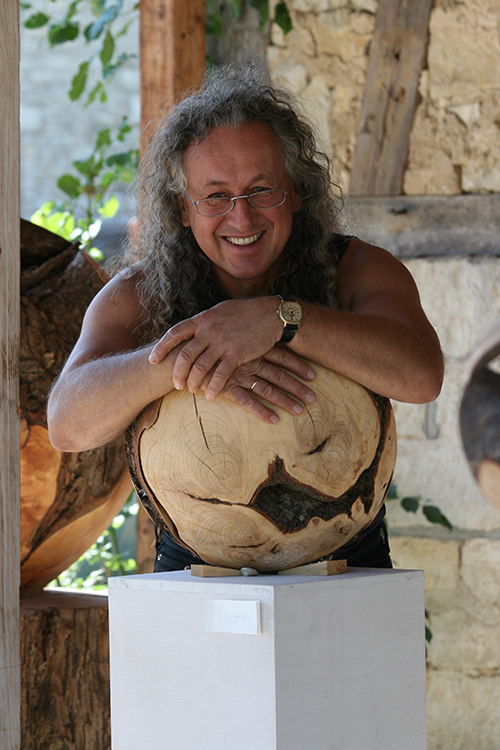
The focus of Staudigl’s work is the circular form, whether as a circle or a sphere. “Reduction is not renunciation, but a conscious decision in favor of what is essential,” says the artist, who keeps spheres of every variation and wood type in his studio.
“Reduction is not renunciation; it is a conscious decision for what is essential.”
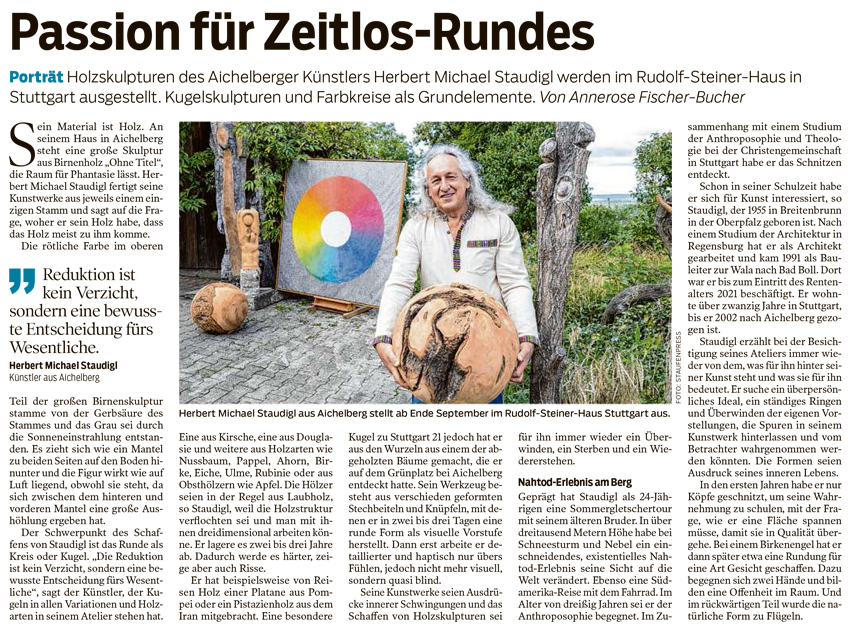
One sphere is made from cherry wood, another from Douglas fir, and others from walnut, poplar, maple, birch, oak, elm, black locust, or fruitwoods such as apple. According to Staudigl, he generally works with hardwoods because their grain structure is interwoven and suitable for three-dimensional work. He seasons the wood for two to three years, making it harder but also causing cracks.
From his travels he has brought back, for example, plane-tree wood from Pompeii and pistachio wood from Iran. One special sphere related to the Stuttgart 21 project was made from the roots of a felled tree he discovered near Aichelberg.
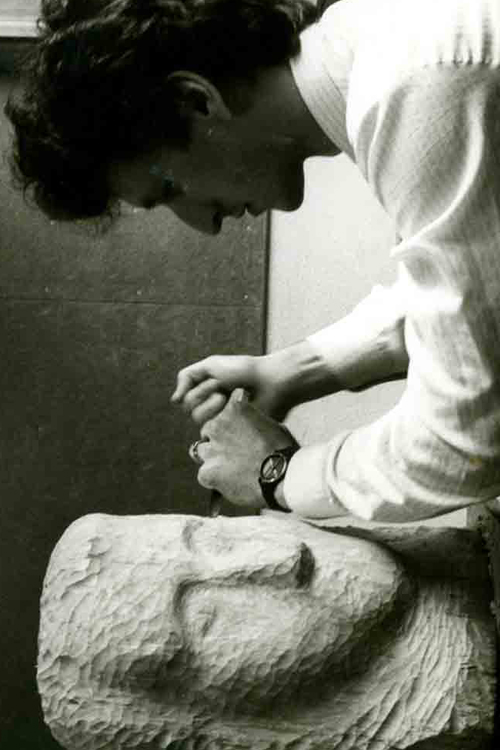
His tools consist of chisels and wooden mallets of various shapes. Within two or three days he creates a rough spherical form as a visual preliminary stage. Only afterward does he work in greater detail, relying mainly on touch rather than sight, almost as if working blind.
His artworks are expressions of inner vibrations, and the creation of wooden sculptures is, for him, a continual process of overcoming, dying, and being reborn.
Near-Death Experience in the Mountains
A summer glacier tour with his older brother had a profound impact on Staudigl when he was 24 years old. At an altitude of more than 3,000 meters, in a snowstorm and dense fog, a life-changing near-death experience altered his view of the world.
A bicycle journey through South America also influenced him deeply. At the age of 19 he encountered anthroposophy. While studying anthroposophy and theology within the Christian Community movement in Stuttgart, he discovered wood carving.
Staudigl, who was born in 1955 in Breitenbrunn in the Upper Palatinate, had already been interested in art during his school years. After studying architecture in Regensburg, he worked as an architect and joined Wala in Bad Boll in 1991 as a construction manager. He remained there until retiring in 2021. He lived in Stuttgart for more than twenty years before moving to Aichelberg in 2002.
During visits to his studio, Staudigl repeatedly speaks about the ideas behind his art and what it means to him. He seeks an impersonal ideal, a continual struggle and overcoming of his own preconceptions, leaving traces in the artwork that can be perceived by viewers.
The forms, he says, are expressions of his inner life. In his early years he carved only heads in order to train his perception. Later, in a birch-wood angel sculpture, he created a curved form suggesting a face. Two hands meet and create an openness in space, while the natural shape at the back becomes wings.
"Talking with wood" (NWZ, 30.09.2010)
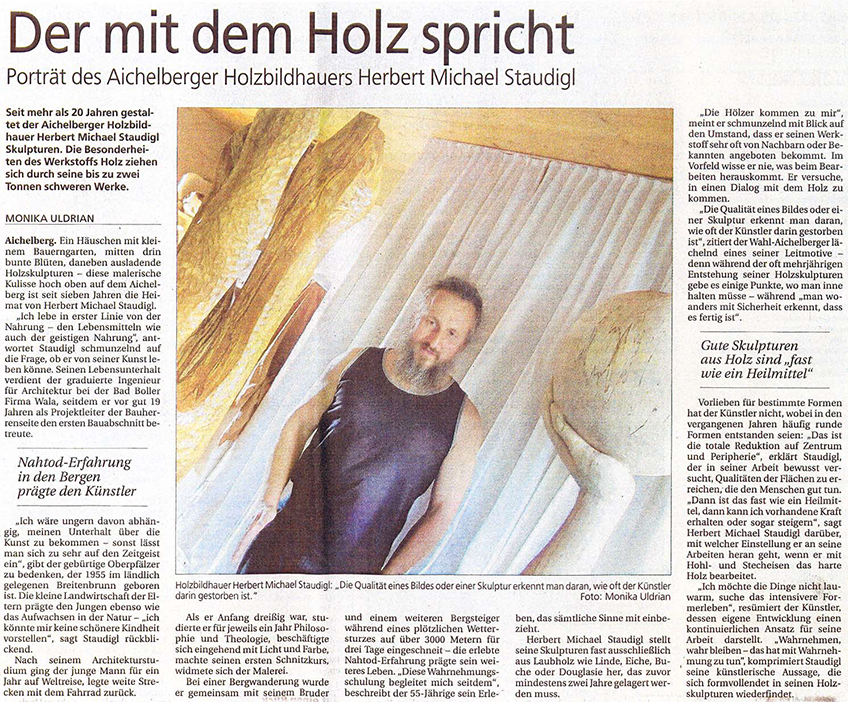
A portrait of the wood sculptor from Aichelberg, Herbert Michael Staudigl
For more than 20 years Herbert Michael Staudigl, who lives in Aichelberg near Stuttgart, has been creating sculptures from wood. The characteristic traits of wood, his favoured material, shape his sculptures which can be as heavy as two tons.
Aichelberg. A tiny house in a small rural garden full of flowers, in the middle of that idyll huge wooden sculptures. This picturesque little spot situated high up at the hill of Aichelberg has been the home of Michael Herbert Staudigl for seven years.
"In the first place I live on food, victuals as well as spiritual food”, is Mr Staudigl’s witty reply when asked if he can live on his art. Having studied architecture he earns his living as an employee of the WALA – company at Bad Boll. He started out there 19 years ago by surveying a reconstructing phase in the WALA buildings.
Near-death experience had a great impact on the artist
"I wouldn’t like to depend financially on my art, as it would make me dependable on the zeitgeist too much", adds the artist, who was born in 1955 in the village of Breitenbrunn in Northern Bavaria. Life on the small farm of his parents as well as growing up in the natural surroundings of this remote rural region has shaped him. "I couldn’t imagine a happier childhood", he reminisces.
After finishing his studies as an architect, the young man went on a one-year journey around the world, also travelling some stretches by bike.

At thirty he took up studying philosophy and theology for a year at a time, he also began to experiment with light and colours and took courses in painting and carving.
During a stay in the mountains he was snowed in for three days in a shelter high up at 3000 meters altitude together with his brother and another person after a sudden fall of temperature. It was here that he experienced near death. And this crisis shaped his whole further development. "This training of my awareness has been part of my life since then", the 55-year-old artist describes his way of perceiving life with all his senses.
Herbert Michael Staudigl produces his sculptures almost exclusively from wood of deciduous trees like lime, oak, beech or douglas fir. The wood has to be carefully stored for at least two years before being worked on.
"The wood comes towards me", he smiles and points out that often he is offered his material by neighbours and friends. He never knows beforehand what the outcome will be when he starts out. As he progresses, he tries to get into a dialogue with the piece of wood he is working on.
"The quality of a picture or a sculpture can be recognised in the fact how often the artist has died in the process of producing it”, thus he quotes one of his leitmotifs and explains that there are sometimes phases in the year-long process of shaping a wooden sculpture when he realises he has to stop and give it a break, "while on the other hand he knows with exact certainty when a work of art is complete".
Good wooden sculptures are like remedies
The artist says he does not have any preferences as far as forms and shapes are concerned, yet in recent years he has produced more and more round-shaped, spheric sculptures."This shape is total reduction, focussing exclusively on centre and peripheriy", he explains. In his ouvre he concentrates on reaching a quality in shaping his material which has a healing impact on people."This is almost like a remedy. If I succeed, I can preserve the intrinsic power of the material or even increase it", he describes his approach and his way of working on the hard wood with chisel and gouge.
"I hate lukewarm approaches and prefer an intense confrontation with material and shape",he says, looking back on his own development as a continuous inspiration for his artistic approach. “Perceiving reality and staying true to reality, that is closely connected,” according to Mr Staudigl this is the essence of his art which is perfectly reflected in his wooden sculptures.